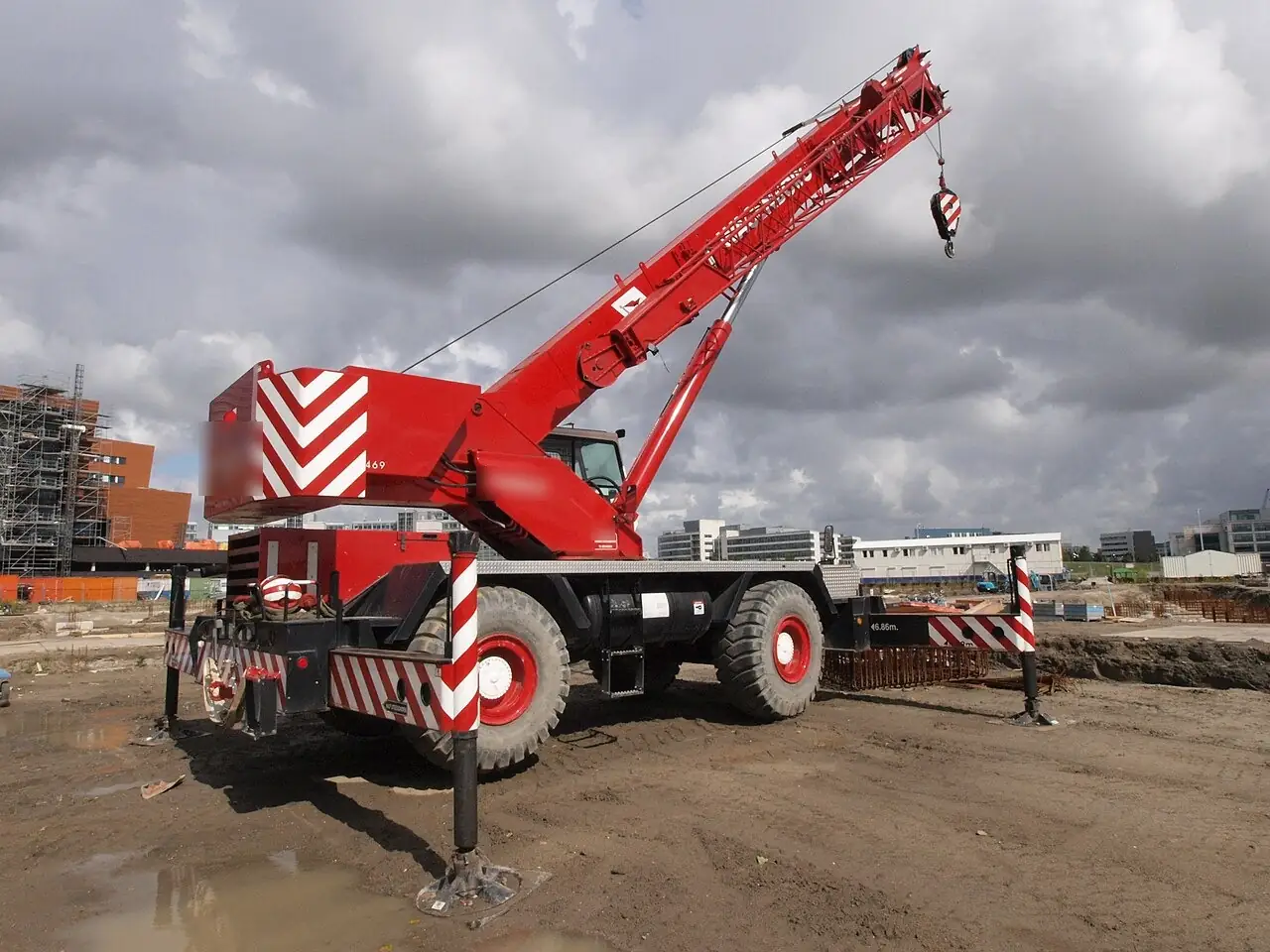
Rough Terrain Crane Rental in Victoria
Big tires, four-wheel drive and a compact footprint for dirt pads, caliche roads and job sites that aren't paved yet.
Unpaved plant laydown yards, port tracts, oil and gas locations and new subdivisions across the Crossroads are classic rough-terrain crane territory—especially on soft, wet coastal-plain ground after rain.
What is a rough terrain crane?
A rough terrain (RT) crane is a telescopic crane on a two-axle carrier with large off-road tires, four-wheel drive and four-wheel steering. One cab both drives and operates the crane. RTs are built for job sites, not highways—they're usually hauled to site on a lowboy trailer and then stay for days, weeks or months.
Best uses
- Unpaved commercial and industrial pads before paving.
- Oil field and energy locations, tank batteries and compressor stations.
- New subdivisions, utility and pipeline work.
- Long-term projects where a crane is needed on and off all day.
RT vs. truck crane vs. all-terrain
| Rough terrain | Truck crane | All-terrain | |
|---|---|---|---|
| Drives on highway | No (hauled) | Yes | Yes |
| Off-road ability | Excellent | Limited | Good |
| Best for | Long stays on dirt sites | Quick in-and-out picks | Heavy picks, varied sites |
RTs still need firm, level ground under the outriggers for most lifts. Some models can pick-and-carry on rubber within limits set by the load chart.
How to choose crane tonnage
A crane's advertised tonnage is its maximum capacity at a very short radius. At real working distances the capacity drops quickly—a "100-ton" crane may only lift a fraction of that at 60 or 80 feet. To size a crane:
- Add up the total load: the object plus hook block, slings, shackles and any spreader bar.
- Measure the radius: from the crane's center of rotation (where it can actually set up) to the center of the set point. Radius matters more than height.
- Check boom length and height: the boom must clear the building edge or obstacles and still reach the set point.
- Leave a safety margin: operators size so the lift stays comfortably inside the load chart; many treat anything above ~75% of chart as a critical lift.
- Account for the ground: soft soil, slopes or buried utilities may push you to a different crane, mats or a different setup spot.
Not sure? Send us the weight, distance and photos—the operator will run the numbers against their load charts before quoting.
Typical uses in Victoria
- Unpaved pads
- Oil field locations
- Subdivisions
- Pipeline & utility work
Request a free quote
Tell us about your lift anywhere in Victoria & the Crossroads. We'll connect you with a vetted local crane operator who will send a written quote.
- Free, no-obligation quotes
- Operated rentals—hourly, daily or monthly
- Hablamos español